
What does quality mean in software?
Software quality isn't about having a cool UX/UI or writing beautifully clean code. It's fundamentally about aligning with customer needs.

Have you ever wondered what the word “quality” truly means in software development? It's a term thrown around so often that its actual meaning can get lost in the noise. For some, quality might conjure images of sleek, intuitive user interfaces and delightful user experiences. For others, it might mean meticulously crafted code, perfectly optimized and beautifully structured. While these aspects can certainly contribute to a positive perception, they don't fully encapsulate what “quality” means in its most fundamental sense.
The uncomfortable truth is: quality isn't about how “cool” your UX/UI is, or how “beautiful” your code looks. It's about alignment with customer requirements.
Let that sink in for a moment. A piece of software can have a dazzling interface and elegant code, but if it doesn't solve the user's problem, or if it fails to meet their fundamental needs, then it simply isn't quality software.
The concept of quality is context-dependent
Let's break down what quality often entails in various software contexts.
One crucial aspect is performance, which asks how fast and responsive the software is, and whether it handles the expected load without grinding to a halt. No one enjoys waiting endlessly for an application to respond.
While not the sole definition of quality, a well-designed User Experience (UX) and User Interface (UI) make software intuitive and enjoyable to use; if users can't figure out how to accomplish their tasks, even the most robust backend is useless.
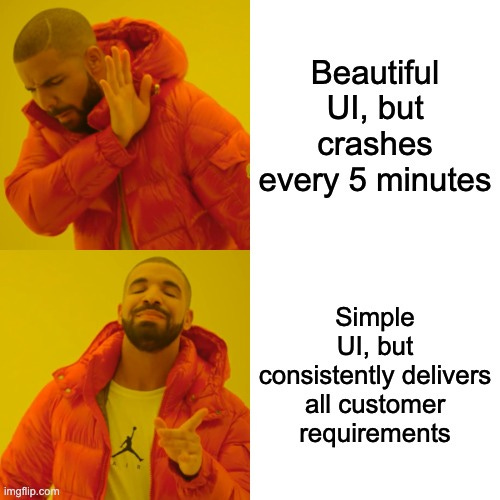
Then there's the concept of being bug-free, or at least very close to it (even if prove that your product is bug-free is theoretically impossible). This refers to how reliable the software is in delivering expected functionality without crashing or producing incorrect results. Bugs frustrate users, erode trust, and can be costly to fix later.
Scalability is another key consideration: can the software handle growing demand effectively? As your user base expands or data volume increases, will your software be able to keep up without significant re-architecture?
Maintainability is also vital, focusing on how easy it is to update, fix, and enhance the software over time. "Write once, debug forever" is certainly not a recipe for quality.
Finally, security is paramount in today's digital landscape; is the software protected against unauthorized access, data breaches, and other cyber threats?
All the points above are absolutely reasonable. However, in some context, especially in high-regulated industry, the concept of quality is well-defined, and it does not (almost) leave room for interpretation.
For example, consider a different context, like Software as a Medical Device (SaMD). Here, the definition of quality takes on an entirely new, critical dimension. It's not just about meeting user expectations or having a pretty interface; it's about ensuring patient safety and compliance with rigorous regulatory standards throughout the entire software life cycle.
For SaMD, quality means patient safety, as software quality directly impacts patient health. Any malfunction could lead to serious risks, so hazard control and risk management are not just important, they are fundamental. Regulatory compliance is also non-negotiable; SaMD must adhere to stringent standards like IEC 62304 (medical device software life cycle processes) and ISO 13485 (medical devices – quality management systems). This ensures rigorous testing, validation, and comprehensive documentation processes. Furthermore, risk management in SaMD involves identifying potential risks at every stage of development and implementing strict controls to mitigate them, often with formal risk analysis and mitigation plans. Lastly, traceability is crucial, meaning every requirement, design decision, test case, and change must be meticulously traceable. This guarantees that the software is not only functional but clinically effective and, most importantly, safe.

The key takeaway? The term “quality” can indeed have different meanings depending on the context. Whether you're developing a life-saving medical device or a fun mobile app to track your fitness activities, it's crucial for everyone involved, from developers to product managers to stakeholders, to align on what quality means for that specific product to ensure everyone is on the same page and working towards the right goals.
Everyone Benefits from Quality (Seriously, Everyone!)
There's a common misconception that investing in quality is a burden, a cost center, or something that only benefits a specific department. Nothing could be further from the truth. There is no single stakeholder that will not benefit from a robust quality process.
For the customer or end-user, this is perhaps the most obvious. Quality software means a reliable, intuitive, and effective tool that solves their problems. It leads to satisfaction, loyalty, and positive word-of-mouth.
Do you remember previous post about “trust”? This is a good way to build trust :)
Imagine using an app that constantly crashes or a website that's impossible to navigate. Frustrating, right? Quality prevents this.
While it might seem like quality processes add overhead, in the long run, they make developers' lives easier. Fewer bugs in production mean less time spent on frantic firefighting and more time on innovation and new features. A well-defined process also reduces ambiguity and rework.
Quality ensures that the product delivered actually meets the market's needs and achieves its business objectives for product managers and owners. It reduces the risk of product failure, customer churn, and costly redesigns. A product manager's dream is to have a product that users love and that performs as expected.
For business leadership and stakeholders, quality directly impacts the bottom line. It reduces operational costs (fewer support tickets, less rework), enhances brand reputation, and drives customer retention and acquisition. But, most importantly, in regulated industries like medical devices, poor quality can lead to severe fines, legal action, and even product recalls, making quality an existential imperative. Investing in quality upfront saves significant money and headaches down the line. And also jail in some cases. :)
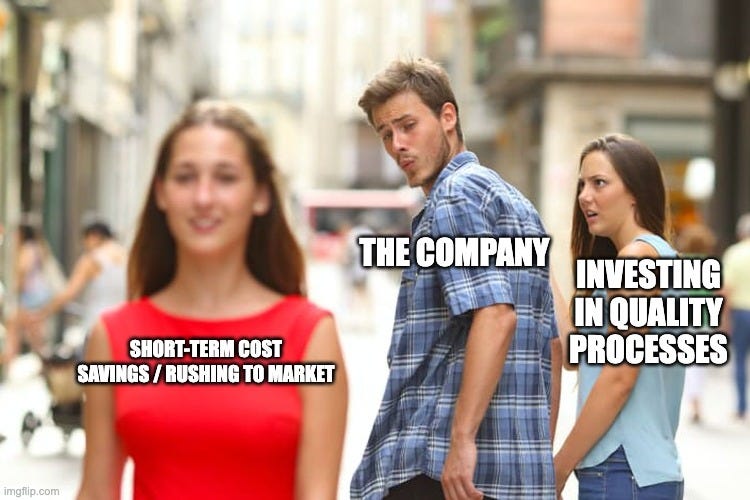
Selling a high-quality product is infinitely easier for sales and marketing teams. They can confidently showcase features and benefits without worrying about underlying issues. A strong reputation for quality is a powerful marketing tool in itself.
Finally, for support teams, fewer bugs and clearer functionality mean fewer customer complaints and support requests. This frees up support teams to handle more complex issues and provide higher-value assistance.
In essence, quality isn't an optional add-on; it's the bedrock of sustainable software development and business success, even for a startup.
But on this last topic we will deep dive. Stay tuned.